Tuesday, October 23, 2018

Escuela Bella Vista, Shining-green hummingbird (Lepidopyga goudoti)

This tiny emerald machine literally dropped out of the sky for lack of enough sugars Well done to the 7th grade girls who found him at the lunch tables (Greta Mici and friends). It took about 20 min of passion fruit juice and love, before he scratched himself (like a green dog with a sword) and zoomed off to be what he was meant to be. What a wonderful creature.
Gotta love Venezuela. Maybe we need to put out hummingbird feeders, so that we keep our shiniest inhabitants happy at EBV.

Friday, August 31, 2018

Rainbow Cloud (The little green iguana) and Mr Napo with the Incredible Hulk

Mr Napo, wrestling the incredible hulk at school yesterday. Our campus seems to be green Iguana refuge. What awesomeness
This little guy was found in a bewildered state in the passage past the main offices. Please keep an eye out for our resident Iguanas.

Friday, August 10, 2018

Hummer stunner.

I am blown away by the intelligence and friendliness of the hummingbirds at school. Not having any South American experience, I am tentatively identifying this little beauty as a Buffy Hummingbird (Leucippus fallax). Just LOVE, the diversity of our campus. Thanks to Wikipedia for the distribution map.

Thursday, August 9, 2018

The Monarch (Danaus plexippus) at Escuela Bella Vista.

Thanks to wikipedia for the distribution map
 These stunning butterflies feed on Milkweeds including common milkweed (Asclepias syriaca). Many milkweeds contain cardiac glycosides which are stored in the bodies of both the caterpillar and the adult. These poisons are foul tasting and cause birds to vommit. After tasting a Monarch, a predator might associate the bright warning colors of the adult or caterpillar with an unpleasant meal, and avoid them in the future.

Wednesday, August 8, 2018

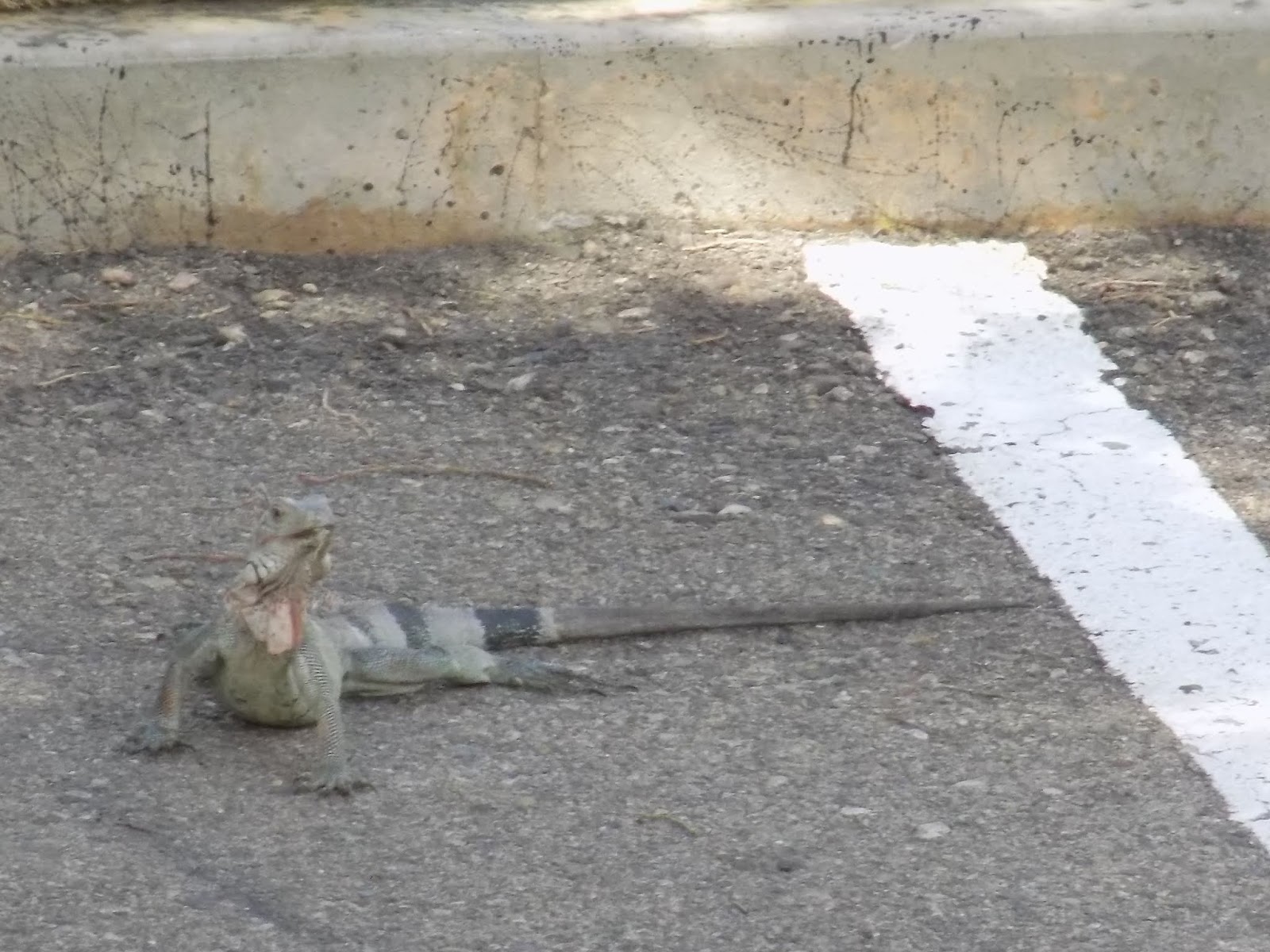
An asphalt mimicry strategy? (designed to avoid predators?)

The green Iguana (Iguana iguana) inhabits the trees around the school but being vegetarian, comes down to feed on the plants in the grass. Every now and again, one can be seen in the parking lot, some of them are colored so close to the grey asphalt that they could be said to "mimic" the tar.

Tuesday, August 7, 2018

Magnificent frigatebird(Fregata magnificens)

Truly this bird was well named, and standing in the Escuela Bella Vista parking lot with twenty of them sweeping over the skyscrapers of Maracaibo makes one grateful for such beauty. The massive wingspan enables them to hang effortlessly in the city thermals. Charles Darwin was apparently so captivated by this species that he named them the "Condor of the oceans". There is clear sexual dimorphism in all frigatebird species. Males have the huge red gular sac, and the females (which I photographed over our school today) have the gorgeous white head. Thanks to Wikipedia for the close up images and the distribution map
.

Orange-chinned Parakeet (Brotogeris jugularis) at Escuela Bella Vista

These delightful little fellows were in the trees around the primary school parking lot. They seem to be common in our area, and they are not flighty. They watch you with a cautious interest. They may adopt a nest cavity that other birds have used, or make a hole in a termite heap like the one shown here at the Garden Botanico Maracaibo. Thanks to wikipedia for the distribution map.

Monday, October 16, 2017

Featuring Feathered Family at AISM: Meet Tifa.


Tifa : "T for tern. Hails from Inhambane where she was attacked by a beach dog that mangled her wing. She is growing stronger every day and should be able to fly away in about a month. Come and visit her in the science block.

Featuring Feathered Family at AISM: Meet BCC

This is BCC, not Blind carbon copy but Birdy Cheep Cheep. (Thanks for the name Jemma) She is a masked weaver from the big fever tree at the foyer of AISM and has been with us for 3 weeks now. She is growing strong and despite deformed feet is going to be a beautiful, strong member of her species. I suspect that she was thrown out of the nest because she could not walk. You can visit her at my class Science block room 2. Mr L.

Featuring Feathered Family at AISM

We are in the season for little birds dropping out of nests! Please take note of the advice displayed here.

Wednesday, August 9, 2017

A "Peachy" welcome back to school


Spring is bursting to break out with a multiplicity of delights. Welcome back to our awakening campus. If you noticed, our winter- flowering Aloes are handing over to the Clivias and the moths and beetles are stirring everywhere.

Keep your eyes peeled for ama-zing beauties like this African Peach moth Egybolis vaillantina. that was discovered on the lawn on front of the cafeteria by Jemma.

The Peach moth though awesomely handsome, should not be eaten (in case you were wondering). It is a clear case of warning color, (the bright orange juxtaposed against the dark shiny blue-green). These day-flying moths feed on a species of Sapindus or soap-berry that provides the toxin that keeps them safe.

Its interesting that the Masai of Kenya are also known to take in saponins from wild plants, and it is thought that the very low levels of serum cholesterol of this tribe is ascribable to the consumption of these herbs.

Please note that neither the moth or the soap berry plant should be consumed unadvisedly. Just enjoy the beauty that is about to unfold.
Len de Beer

Saturday, October 22, 2016

Welcome Sugarplum


Sugarplum the owl has joined us on campus for a few weeks. We are currently working on long flight training and "attack the gecko" skills so that release into the Elephant reserve can be achieved. Please pop in for a visit if you want to meet her.

Friday, October 21, 2016

Bioblitz adventure to Macaneta


We have some good news to share with you about yesterdays Service learning day. The Bioblitz team went out for a few hours to Jays lodge in Macaneta. It turns out that a very special dung beetle lives out there.

 The Vondeling boys, Wouter and Joris were hanging around at the back when they found two little dung beetles. I posted pictures of the scarabs to the ADU. It turns out that they were scientifically described only last year. Meaning that, had we found them last year they might have been named Scarabaeus vondelingensis. What we do out there really helps, The scientists now have a better idea of the range (distribution) of this particular gorgeous dung beetle. Well done team Bioblitz.
Thanks goes to Chistian Deschodt from the ADU for identifying our scarab.

Tuesday, April 12, 2016

A !Kwe (fossilized doughnut) unearthed by our building activities at AISM.

Confusion about these weird fossilized bagels is rife around the world, it seems to be a stone age technology that can be found from the Santa Barbara channel region, to the Congo, to the American school of Mozambique. Our specimen was unearthed with the current building efforts at the seaward side of campus. Yes, I was surprised to find it in the dirt after a pipe was laid between the science and the math blocks.

There are records pretty much like the AISM specimen, in round stone from  the Gulf Coast of Mexico, to the Guatemalan highlands and on some Pacific islands. These petrified, perforated rock rings show a diversity of design that indicates a similar diversity of uses.

Southern African San beliefs suggest that these so called digging stick stones had a special significance beyond everyday use. Bushmen women would communicate with Shamans and contact the spirit world by beating the ground with a bored stone from a digging stick.

It would seem that although European explorers saw and recorded both San and Bantu peoples using these stones, no-one recorded them making them. The San themselves allegedly claimed that they found the stones already drilled.

There is the possibility that they were also used as mace heads, and some archaeologists feel that they were once used as currency. Well there you have it then, the first ancient multi tool. Move over Swiss army knife.


Noah with the !Kwe at the discovery site

Friday, February 5, 2016

AISM welcomes our most recent furry visitors: Epauletted fruit bats.


Epaulettes are a type of ornamental shoulder decoration used by armed forces as an indication of rank, and yes, the bats have them, but only the males, who use them to show off.


We have a small colony of around five Wahlberg's epauletted fruit bats (one with a baby) who have graced the fig trees in the primary playground. They are fruit eaters and may be here for the duration of the fruiting season. Thereafter that may choose to move on to another roost. It is a great privilege for us to have these friendly mammals here. Please treat them with respect. No loud noises please.


Friday, November 6, 2015

What to do with fledglings and nestlings?


It’s that time of year again and we often get little birds “lost” on campus. Please refer to the following flow diagram when deciding what to do with them. If you make sure the students see the poster by displaying it in your class then we will be able to get rid of some of the most prevalent myths concerning baby birds

The little fellow pictured above seems to be a fledgling that belongs to the Southern black flycatcher who frequents the big Mahogany tree. After we left baby out on the deck she found it and probably led it somewhere safe.


Malik meets mobile moustache at Macaneta Mozambique!

Bioblitz report


Lassiocampidae (Eggar moth): the name gave me no indication of the visual impact of the  prehistoric animated Cuban cigar with highlights in its hollow venom spears that Malik found wrapped around a pod mahogany branch on Macaneta. I have seen a fair number of forgettable caterpillars but this one …

Speaking from a complete lack of experimental evidence. A carefully planned lack, I might add. I can say that this creature is not something one would want to mess with, physical contact with those spines can cause a type of histamine release and dermatitis called Lepidopterism.

Toxins from the hairs are likely to spill out if broken off, and these moths are prone to lash about forcing hairs into the skin if they feel threatened. People who are allergic to the toxins are in for a torrid time.

The weird name “Eggar” moth is derived from the egg shaped cocoon of some species of which there are over 2000 kinds on earth (some as yet undiscovered). Maybe the caterpillar should be called the animated victorian moustache. You never know what you are going to find out there, that’s what makes exploration time in the bush so cool.

Len